Thursday, February 7, 2013

Lemon Battery Lab (Real World Connection)

Link:

Inside of all of our iPads is an Lithium ion battery. Made out of polymer, this battery is unique because unlike most other batteries, it can be recharged. Apple says that for the first two hours of charging, your iPad battery will charge up to 80%. For the next two hours it will "trickle charge" slowly to complete the charge at 100%. With each new iPad release, the battery life has always stayed the same (10 hours), so we're led to believe that they won't be focusing on increasing the battery life time, but focusing more on expanding the capabilities of the ipad during those 10 hours. 

Real World Connection:
These iPads are really very complicated innovations, and thankfully, learning many of these new concepts in class helped me to better understand how they work. In the past few class days we learned about voltage and electricity and how they relate to each other. One analogy we used to help us learn was that voltage was similar to a gravitational field, surrounding an object. But I think the most helpful piece of information was learning how regular batteries work. The electrons from the (-) side flow through the electronic device into the (+) side, and eventually the (-) electrons will run out and the battery will die. I really felt like this concept was the most helpful while learning about all different types of batteries, like the ones in our iPads. 

Sunday, January 20, 2013

Projectile Motion Reflection on Learning

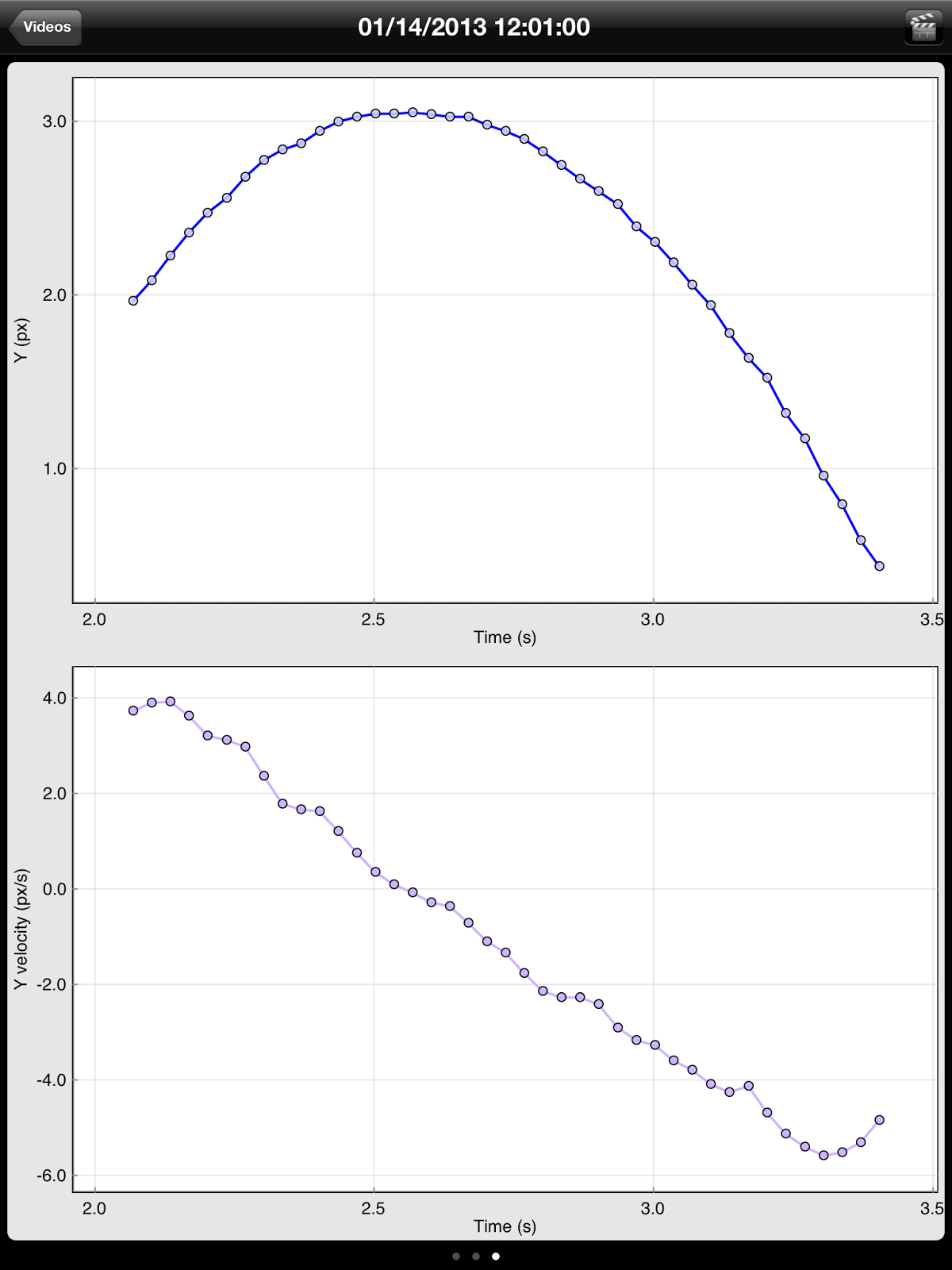
     In our most recent lab, we performed an experiment which helped us to better understand what a projectile is and which forces are acting on it. We began by taking a basketball and shooting it into the air at an angle. By taking a video of this, we were able to create some graphs and visual images that would help us understand the ball's pattern in the air. 


      These screenshots show graphs that each give different information about the projectile (basketball). The two bottom graphs in particular show the velocity of the ball in relation to the amount of time it was in the air (Vx and Vy).  The bottom right graph shows us a line which crosses the X-axis at some point. Looking on the graph, we see that it crosses the axis at around 2.5 seconds. This is the exact time at which the ball is at its peak. It has stopped going up and has not yet started falling down. 
      I think the most important concept I learned from this lab was that all projectiles only have one force acting on them. In this case the force was gravity. All of our work is shown below on our whiteboard:


Saturday, January 12, 2013

Forces in 2D & Circular Motion (Big Questions)

Questions:
1. What does it mean to analyze forces in 2D?
2. How do forces cause objects to move in a circle?
3. What does it mean to be in orbit? How do satellites orbit planets? How do the planets orbit the sun?

Response:
      In the past week of physics class, we've started studying forces in 2D. For example, if we were to see a tension force of say 60N acting on an object, we would also be asked to calculate the Fy and the Fx values. This type of work really goes back to geometry where we used SOH CAH TOA to help us find our x and y values. Overall, finding these values can help us to calculate the net force acting on the object and help us to better understand the problem.
      We also performed a few labs during the week that helped us to understand these forces. In our hover disk lab, we learned more about how tension can keep an object moving in a circle. We had a string connected to our hover disks and simply spun the disks around us in a circle. The disk continued to move in a circle around me because I was holding the string (tension force) that kept it going in circles. (Although the hover disk was moving at a constant speed, it was technically accelerating because it was constantly changing directions.) However, if I were to release that string, the disk would fly off in a straight line (90 degrees from the tension string) and continue getting farther and farther away from me.
      This concept of tension keeping an object going in circles also helped me to understand how things can stay in orbit. Instead of a tension force, simply think of a gravitational force. When something is in orbit, it is constantly moving around another object. Think of satellites. The satellites that stay in orbit are technically falling towards the earth at all times. They just go so fast while "falling" that they miss the earth and continue going right back around again. This same idea also applies to the planets orbiting the sun.

Sunday, November 18, 2012

Newton's 3 Laws of Motion


      Over the past few weeks, we've been learning about a couple very important physics topics. We've covered the relationships between mass, force, and acceleration; and we also went over Newton's 3 laws of motion. 

Fan Cart Lab:
      In this lab, we covered the relationships between force, mass, and acceleration by using a fan cart to measure accelerations. We began by finding the force of our fan cart set on high by placing a force probe on our track. (Shown below)


      We found our force value to be -0.234 which we would later use to create our equation. We then proceded by measuring the acceleration of the cart with a variety of different weights placed on it. Using the logger pro application on the computers, we found the acceleration of the cart by looking at the slope of our graph. (Shown below)


(After collecting all of our data, we were able to organize everything into a data table as shown on our whiteboard.)


      After completing our lab, we used our data values for force, mass, and acceleration to come up with the equation F = ma. (Force equals mass x acceleration) Our values for mass and acceleration didn't exactly match up with our force value when we plugged them into our equation, but after going back again to find a more exact force value, we found a better number that made more sense with our equation. We just didn't take our time when trying to find the force value the first time. 

Newton's 3 Laws of Motion:
      Aside from finding our F=ma equation, we also learned about Newton's 3 laws and how they applied to our everyday lives. 

Hover Disk Lab:
       In this lab, we spent most of the time sliding a hover disk across the floor and trying to figure out all the forces that were being felt by it. It was actually a tricky lab because we not only had to find the forces that applied to the disk, but also the forces that applied to the earth and each other. 
      For example, if I were to shove the disk over to my partner, there are lots of forces interacting that we usually don't think about. We were able to show these interactions with different diagrams.

(As we can see from the interaction diagram above, there are normal forces and gravitational forces acting between all four of the "objects" involved.)

      We continued this lab with many more different scenarios involving the hover disk. Overall this lab just helped us to better understand the relationships going on between different things in our lives.

Newton's 1st Law:
Newton's 1st law states that any object at rest or constant speed will remain at rest or constant speed. This law applied to our hover disk lab, because we saw that if we left our disk alone and didn't push it, it would stay in the same spot. This law also applied when we pushed the disk across the floor and it continued moving at a constant speed because it was feeling no friction with the floor. 

Newton's 2nd Law:
Newton's 2nd law states that acceleration is produced when a force acts on a mass. This law applied well to our fan cart lab where we found our own force values, and then used the acceleration from the fan cart, to arrive at the equation, F = ma.

Newton's 3rd Law:
Newton's 3rd law states that for every action, there is an equal and opposite reaction. Now we didn't have any labs that specifically applied to this law, but we talked about it a lot during class. For example, if someones hand were to press down on a table, that same force being applied to the table is also being equally applied to that hand. 

Real World Application:
      There are actually a lot of real world applications that we could take from these past few weeks. However, I think that Newton's 3rd law is the most common law that all of us have experienced without realizing it. 
      One of the best examples I can think of comes when watching baseball games. We don't think about it, but when the player's bat collides with the baseball, that is an example of equal and opposite reactions. Or when a football player kicks a field goal, there are equal and opposite reactions between his foot and the ball. But above all, the best visual example of Newton's 3rd law comes from the Newtons Cradle.


Saturday, October 27, 2012

Impulse Lab


Lab Work:
      In our most recent lab, we performed experiments using the equation for momentum,
P=mV, and the equation for Impulse, J=P(after) - P(before). 

      Our actual test consisted of crashing a cart with a metal ring into a force probe stand with a metal ring. The force probe helped us to calculate the force of the collision. And at the end of the track we also placed a sonar device, which allowed us to calculate the velocity of our cart before and after the collision. We had to perform this test a few times in order to get the data we needed to use. 


(The graph above shows the data we collected from our collision. The blue bar on the bottom was the data we used to find our velocity before and after the collision.)


      Our whiteboard above shows the calculations we made after completing our lab. We used the momentum equation, P=mV to find the momentum of the cart before and after the collision. The mass remained the same at 0.25k. Before the collision, the velocity was 0.3714m/s, and after the collision the velocity was -0.3421m/s. After we had our values for momentum, we subtracted the momentum before the collision from the momentum after the collision. This value would be our impulse for the collision. 
(We also calculated our percent error as shown on the board and found that we had a twenty percent difference.)

Real World Application:
      In our world today, one example of this lab would be a car crash. Now this type of car crash wouldn't involve another car like some of our previous labs. Instead of a car crashing into another vehicle, this car would crash into a wall or something immovable. 


Crash test cars are an excellent example of this concept in real life. By crashing a car into a solid wall, people are able to record impulse, momentum, velocity and many other important factors just like we did in our impulse lab. 

Thursday, October 11, 2012

Collisions Lab

Big Question:

"What is a better conserved quantity - momentum, or energy?"
-After completing our collisions lab and collecting our data, we found that momentum is a better conserved quantity as opposed to energy. With energy, both cars start out with kinetic energy, but when they collide, the energy is transfered to heat, or possibly friction. 

Lab Work:
      We began our lab by setting up two cars on a track facing each other. On either end of the track itself we had sonar sensors which would allow us to calculate the velocity of the cars. Our first test was "elastic" meaning that each car would have springs colliding with each other on the ends of the cars. The red car was stationary and we rolled the blue car into it. The blue car stopped moving and the red car was pushed down the track.This was our first test for the "elastic" collision.

      Our second test was an "inelastic" collision where we took the springs away from the cars. This time, when we ran the blue car into the red car, both cars stayed together and continued rolling down the track. 

      Our data involving momentum, energy, and velocity are recorded below:

(We used the formula, P = mv, to calculate momentum, and the formula, K = 0.5mV^2, to calculate the energy.)


Percent Difference:
      This whiteboard shows how we calculated the percent difference of energy and momentum. We calculated the percent difference of the energy and momentum by first subtracting the "before" number from the "after" number. Then we divided that number by the average of the two numbers. We then took that number and multiplied it by 100 to give us our percent difference value.


Real World:
      In our world today, one of the most obvious examples is a car crash. When one car crashes into the other, both of the cars continue moving a little. The kinetic energy of the cars is transfered into heat or friction and the momentum of the cars is conserved. This is an example of an "inelastic" collision as performed in our lab. 


Sunday, September 30, 2012

Rubber Band Cart Launcher Lab

Big Question:
"How are energy and velocity related?"
-From our lab, we were challenged to work with many different equations that helped us relate energy to velocity. We used the equation for spring potential energy, kinetic energy, and gravitational potential energy. By using these various equations, we were able to calculate values and relationships between energy and velocity.


Lab:
This lab was like a sequel to our previous lab with the rubber bands. We used the same setup with the air track and rubber band. Only this time instead of finding the force required for the rubber band, we were testing an entirely new concept of velocity. 
      We used equations we learned in class like the kinetic energy equation, K = 1/2mV^2, to help us calculate the velocity. 
      Our testing was basically just pulling the red glider back a certain distance in meters, then letting it go on the air track. After being released, the glider would pass under a velocity recorder. We connected this recorder to our labquest devices and were able to find the speed of the glider being pulled back at various distances. 


(Whiteboard showing our data plotted on a graph using Vernier Graphical Analysis.)

      After gathering all our data, we averaged it, squared it, and from there we could plug it into our equation to find the energy if we wanted to. This lab wasn't really about finding the energy, it was mainly just about getting practice with velocity and how it can relate to different forms of energy.


Today's World:
      In our world today, these concepts of potential energy, kinetic movement, and velocity can be easily seen at any amusement park. Roller coasters may seem like fun and games, but there is actually a great deal of physics involved in these rides. When the car is stalled at the top of a hill on the roller coaster, it still has potential energy. When it slowly creeps forward and starts to plummet down the track, the potential energy is converted to kinetic energy and this movement carries the car around the rest of the track because no energy is lost, it only changes forms.